
From Service to Shelf: The Manufacturing Lessons Behind Global Insync’s Rise
From Service to Shelf: The Manufacturing Lessons Behind Global Insync’s Rise. Global Insync’s story begins in 2014, not on a factory floor but inside office parks and townhouse complexes across Gauteng. Founded by entrepreneur Xolile Khumalo, the business initially operated as a cleaning and maintenance service. Day after day, her team cleaned offices and residential spaces, relying heavily on chemical products that were purchased from other suppliers.
That daily exposure became the spark for something bigger. As Khumalo worked through the operational side of the business, she noticed just how much was being spent on cleaning chemicals. Instead of seeing this as a fixed cost, she saw it as an opportunity to learn how those products were made.
Before shifting direction, she invested in her own skills. Khumalo completed manufacturing courses with the University of Johannesburg. That decision marked the first major turning point. It moved Global Insync from being a service based business into a company built on production, formulation, and long term value creation.
Falling in Love With Manufacturing
Once she completed her studies, Global Insync began manufacturing its own cleaning products. What started as a practical move to support the cleaning business quickly became the heart of the company.
Khumalo has spoken openly about how the process changed her perspective. Learning how to formulate products, manage quality, and understand compliance revealed a deeper passion for manufacturing itself. Instead of competing only on service pricing, Global Insync was now building intellectual property and product capability.
This phase laid the foundation for the Crysta Clean brand, which focuses on household cleaning solutions designed for everyday use. It also set the stage for the company’s most defining strategic move.
Identifying a Gap Others Missed
While many manufacturers focused on either cleaning chemicals or beauty cosmetics, Khumalo noticed something missing in the market. There was limited local manufacturing dedicated specifically to baby care products that prioritised gentleness and safety.
Rather than rushing to launch, she chose a development driven approach. Global Insync partnered with the Tshwane University of Technology to support formulation, development, and testing. From concept to completion, the process took approximately two years.
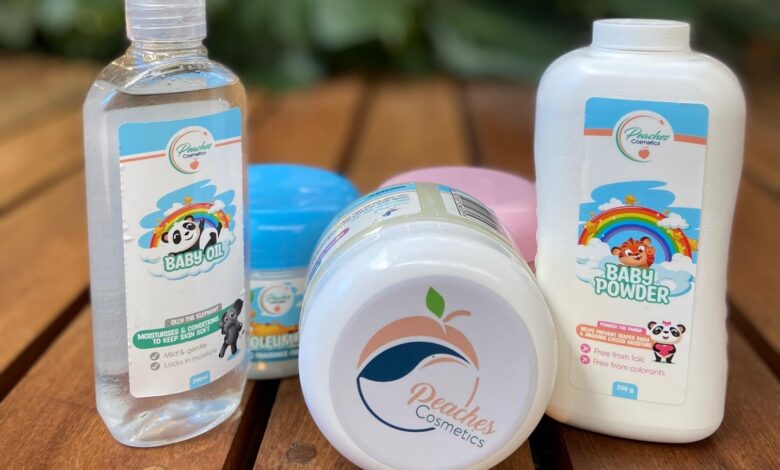
That patience resulted in the launch of Peaches Cosmetics, a baby care range that includes baby powder, petroleum jelly, and lotion. The extended development period ensured the products met required standards before reaching consumers.
Winning Trust Through Distribution
One of the clearest indicators of Global Insync’s progress is where its products are sold. The Peaches Cosmetics baby range is stocked nationwide in Dis Chem Baby City, listed on Amazon, and available in selected Checkers stores in Krugersdorp and Pretoria.
Online retail has played a particularly important role. According to Khumalo, Amazon has become a powerful growth channel, with the brand ranking among the platform’s top sellers in its category. This visibility has helped the business reach customers far beyond its physical footprint.
Expansion has remained measured and deliberate. The company has confirmed plans to extend the Peaches range with an aqueous cream and a baby body wash, continuing the focus on essential baby care.
Building Capacity With Strategic Support
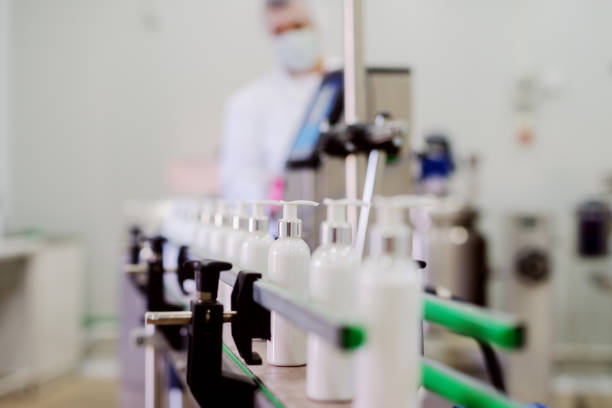
Growth has not relied on sales alone. In 2021, Global Insync received critical support from the Small Enterprise Development Agency, now the Small Enterprise Development and Finance Agency. Through this intervention, the company acquired manufacturing equipment valued at R250 000, including a mixing tank, batch coding machine, and shrink wrap machinery.
These assets strengthened production efficiency and quality control, allowing the business to meet retail standards more consistently. Global Insync currently operates from the Lepharo Centre incubator in Munsieville and employs seven people, reinforcing its role as a growing manufacturing employer.
Looking Beyond South Africa
While local retail remains central, Global Insync has also begun positioning itself for international exposure. With support from the Department of Trade, Industry and Competition, Khumalo has participated in global exhibitions, including a 2024 trip to China for equipment sourcing and an appearance at the Intra Africa Trade Fair in Algeria.
These experiences have confirmed demand for South African manufactured products, particularly across the African continent. Rather than exporting ambition alone, Global Insync is building capacity and compliance first, then entering new markets with confidence.

Lessons From the Global Insync Journey
Global Insync offers clear lessons for aspiring entrepreneurs. First, opportunity often exists inside the work you are already doing. Khumalo did not chase a trend. She responded to a problem she understood deeply. Second, skills development matters. Formal training gave her the confidence to shift into manufacturing. Third, patience pays off. Two years of development created products that could compete nationally.
Perhaps most importantly, the journey shows that manufacturing success is built step by step. From cleaning services to production lines, from local shelves to international exhibitions, Global Insync reflects what focused growth looks like when learning, partnerships, and execution move in sync.